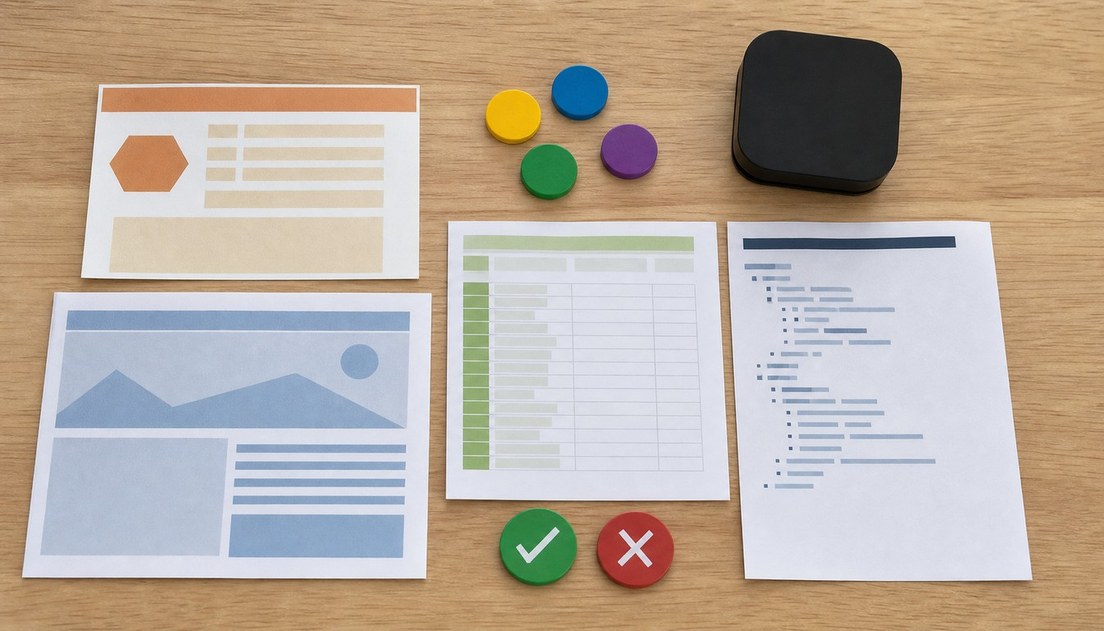
Evaluate a CMS Using Representative Publishing Scenarios
A vendor-neutral method for comparing shortlisted CMS platforms through buyer-run publishing scenarios, failure tests, evidence and operational constraints.
Use requirements to screen the CMS market, then decide among shortlisted platforms by asking representative users to run the same buyer-owned publishing scenarios. A polished demonstration may prove that a configured system can publish a page, yet reveal little about a stale translation, approval of the wrong revision, failed timed release or urgent rollback. Comparable tests make the operational cost visible: the steps, permissions, configuration, plan tier, integrations, specialist help and manual controls required to produce the promised result.
Key points for the shortlist
Screen every candidate against mandatory architecture, security, accessibility, data, legal, commercial and support constraints before scenario testing.
Fix the content, actors, starting state, expected outcome, failure variation and evidence before each test begins.
Use the same versioned scenarios for authoring, review, localisation, reuse, permissions, scheduling, correction, archiving, integration and recovery.
Record a demonstrated outcome separately from effort, configuration, plan tier, extensions, custom code and external dependencies.
Treat proof-of-concept success as bounded evidence, not certification of production performance, compliance, accessibility, security or continuity.
How should a CMS evaluation move from screening to operational proof?
Requirements should narrow the market; comparable buyer-run scenarios should generate the evidence for the final decision. Remove candidates that cannot meet non-negotiable architectural, security, accessibility, data, legal, commercial or support constraints. Then give each surviving platform identical samples, actors, starting states, expected outcomes and failure conditions. Government Digital Service guidance supports testing needs, interfaces, data, compliance, security considerations and technical constraints through prototypes before long-term commitment, although its institutional process is not a private-sector procurement standard.
Treat the ten scenario families here as an adaptable editorial framework, not an official standard or universal prescription. Version every scenario card and sample so a mid-evaluation change does not quietly favour a later candidate. Let representative staff attempt the normal path before a vendor explains configuration or demonstrates a shortcut. This preserves the value of vendor expertise while showing what an occasional author, reviewer, release coordinator or integration owner can actually accomplish under the agreed conditions.
What must every repeatable CMS scenario specify?
Every repeatable scenario must define the test conditions, observable result, required evidence and cost of producing that result before anyone touches the CMS. This prevents an impressive workaround from being recorded simply as success. Prototype-based evaluation can expose assumptions about users, interfaces, data, compliance, security and technical constraints; the card below turns that broad principle into a buyer-oriented method. Adapt its fields to local governance, but keep them consistent across candidates.
Purpose and buyer-owned sample: state the operational question and supply realistic content, assets, locales, role rosters or payloads.
Actors and starting state: name the users and fix the workflow, permissions, content, environment and integration state.
Task, variation and outcome: describe the normal path, one meaningful complication and what must or must not happen.
Evidence: capture rendered pages, screens, audit entries, API responses, exports, timestamps, notifications and participant observations.
Effort and dependencies: record elapsed time, steps, hand-offs, prompts, configuration, extensions, custom code, plan tier and external help.
Failure condition: mark the result failed or open when a must-pass outcome is missed, state is ambiguous, evidence is absent or dependency remains unresolved.
A feature claim says a CMS can act; a representative scenario shows what your organisation must do to achieve the outcome.
How should authoring and review scenarios expose everyday workflow risk?
Authoring and review tests should prove that representative users can create accessible structured content and release the intended revision without collapsing separation of duties. Ask both a frequent and an occasional author to build the same article with headings, links, an image and alternative text, metadata, a related-content reference and responsive previews. Add a keyboard-only critical path and a validation or accessibility mistake to correct. W3C's ATAG scope covers both authoring-interface accessibility and support for producing accessible content, but this bounded exercise cannot establish ATAG or WCAG conformance.
Keep the current page live while an author submits a revision, a reviewer comments and returns it, the author corrects it and an authorised publisher releases it. Drupal documents a model in which a published version remains live while a working revision moves through states and transitions. During review, create a newer parallel draft and record which revision receives approval, what each role can change and what the history retains. That collision test is an operational recommendation, not a requirement that every CMS implement workflow identically.
How can localisation and reuse tests reveal hidden content dependencies?
Localisation and reuse tests should reveal exactly which source, state and dependency reaches each destination. Create a secondary-locale edition, review and preview it independently, then publish it without changing the source edition's state. Next, alter the source after translation has begun and leave one localised field blank. Drupal documents separately moderated translations that may begin from the published source rather than its latest working revision, while Contentful documents requested locales, a default locale and configured fallbacks. These examples show why the delivered response must be inspected rather than assumed.
For reuse, reference one governed fact, disclaimer, profile or contact block from several destinations. Update it once, inspect every dependency, preview the affected uses and release only the intended set. Contentful documents that references can reuse an entry and that a published update can appear in those uses; it does not establish what every frontend, cache or rollback process will do. Make one destination require different wording or timing and verify that the exception remains explicit instead of creating an untracked copy.
What should permissions, scheduling and correction scenarios prove?
Permissions, scheduling and correction scenarios should prove effective control at real boundaries, observable timed execution and accountable recovery from a live mistake. Assign least-privilege author, reviewer, translator, publisher and administrator roles, then attempt allowed and forbidden actions through controls, direct routes and relevant APIs. WordPress documents capabilities that distinguish reading, editing, publishing, importing, exporting and administration, illustrating why a familiar role name is insufficient evidence. Add a restriction for one content type, field, locale, business unit or transition and capture every denial.
Schedule linked content and assets for publication and later withdrawal in a named IANA time zone, then introduce a validation failure or last-minute time change. Contentful documents scheduled actions with dates, time zones, permissions, notifications, validation failures and product-specific limits. Record preflight results, dependency scope, execution timestamps, public state, partial-release behaviour and recovery. Finally, correct a material live error, verify all delivery channels and caches, then restore the prior approved revision. WordPress revision records can expose content, authors, timestamps and statuses, but storage alone does not prove safe rollback or cache convergence.
How should archiving, integration and recovery be tested without overstating the result?
Archiving, integration and recovery should be tested as distinct operational outcomes, with every conclusion limited to the exercised sample and environment. Define retirement first: retain the page with an explanation, unpublish and redirect it, restrict it, delete it or apply another explicit state. GOV.UK guidance distinguishes withdrawal that retains a URL from unpublishing that removes content and can establish a redirect, but those are platform examples. Reverse the decision and inspect URLs, links, search, feeds, APIs, attachments, history, permissions, analytics continuity and downstream effects.
Challenge the intended API or connector with realistic content, invalid input, a repeated request and a delayed or failed consumer. The WordPress REST API documents anonymous public access and authenticated private management actions, but an endpoint says nothing conclusive about an organisation's mapping, observability, ordering, retries, resilience or scale. CMIS likewise defines a common repository model and bindings without exposing every repository capability. For recovery, export the agreed models, content, assets, relationships, identifiers, redirects and operational state, restore a representative set in isolation and record gaps and elapsed effort.
Keep that restore conclusion deliberately narrow. NIST describes contingency planning as coordinated plans, procedures and technical measures for recovering systems, operations and data after disruption. A CMS trial can therefore inform recovery planning, but it cannot certify production recovery, disaster recovery or business continuity. Qualified infrastructure, security and continuity professionals should set recovery objectives, assess production dependencies and repeat exercises at the level of assurance the organisation requires.
Ten adaptable CMS scenario families and the evidence that makes each result comparable
Scenario family and buyer-run task
Expected observable outcome
Decisive evidence
Failure or exception variation
Authoring: two representative users create structured content
Valid content and previews retain required structure
Entry, preview, keyboard path, timing and assistance
Correct an accessibility or validation mistake
Review: route a working revision to publication
Only the intended approved revision goes live
States, comments, identity, timestamps and history
Create a newer parallel draft
Localisation: publish a secondary-locale edition independently
The intended locale and metadata are delivered
Locale status, fallback result and delivery response
Change the source and omit one field
Reuse: update one governed item used in several destinations
Only intended dependencies receive the approved change
Impact preview, destinations, order, caches and rollback
Give one destination a contextual exception
Permissions: attempt allowed and forbidden actions
Permitted work succeeds and restricted work is denied
Interface results, API responses and audit identity
Restrict one field, locale or transition
Scheduling: coordinate timed publication and withdrawal
Dependencies execute in the named time zone
Preflight, timestamps, notifications and public state
Trigger validation failure or change the time
Correction: fix and reverse a live error
Channels converge on the approved revision
Comparison, approval, cache checks and audit record
Restore the prior approved revision
Archiving: retire content using a defined treatment
URLs and discovery surfaces show the required state
Responses, redirects, search, assets and history
Reverse the retirement decision
Integration: exchange realistic content through the intended interface
Systems reconcile content, identifiers and status
Requests, responses, events, logs and duplicate behaviour
Repeat invalid input or fail the consumer
Recovery: export and restore a representative dataset
Agreed content and relationships restore with documented gaps
Export, procedure, elapsed effort and validation
Recover after deletion, corruption or unavailability
How should teams turn scenario evidence into a defensible CMS decision?
Teams should separate must-pass gates, observed outcomes, operational effort, dependencies and open risks instead of compressing everything into one persuasive score. Record each mandatory outcome on its own so a strong usability rating cannot conceal a disqualifying failure. Attribute success to native capability, configuration, plan tier, add-on, extension, custom code, partner service, external system or roadmap commitment. Government Digital Service guidance considers adaptability, control of stored data, security risk and total ownership cost, but supplies no universal CMS scoring formula. Set local gates, weights and thresholds before testing.
Convert unresolved training, configuration, migration, integration, testing, manual-control and operational work into implementation scope, cost, contract terms, an explicit risk or rejection. Retain the versioned scenario cards, samples, participant roles, observations, timestamps, screenshots, API records, exports, dependency assumptions, gate results and decision log. This packet gives procurement a defensible record and gives implementation teams assumptions they can verify. Bring in qualified accessibility, security, privacy, legal, data, infrastructure and continuity professionals wherever the decision requires conformance, compliance, threat assessment, production resilience or recovery assurance beyond a bounded scenario.
CMS evaluation questions
How do you evaluate a CMS?
First screen candidates against mandatory architectural, security, accessibility, data, legal, commercial and support constraints. Then ask representative users to run the same predefined publishing scenarios with buyer-owned content, fixed starting states and observable outcomes.
What should a CMS proof of concept include?
Include realistic samples, named actors, an exact starting state, the normal task, a meaningful failure variation and a predefined outcome. Capture evidence, elapsed effort, hand-offs, training prompts, configuration and every plan, add-on or external dependency.
What should a CMS vendor demonstration prove?
It should show how the platform handles the buyer's versioned scenarios and content, including exceptions and failure states. Representative users should attempt the default path before the vendor explains configuration, workarounds or specialist options.
Which publishing scenarios should an enterprise CMS evaluation test?
Use an adaptable set covering authoring, review, localisation, reuse, permissions, scheduling, correction, archiving, integration and recovery. Tailor the samples and must-pass outcomes to the organisation rather than treating the set as a universal product standard.
How should CMS evaluation results be scored?
Keep mandatory gates separate from observed outcomes, usability, effort, dependencies and unresolved risks. Set weights and thresholds before testing, and never allow an aggregate score to offset a failed non-negotiable requirement.
References & Sources
This article was researched using the following sources:
We cover the decisions that shape a website long after launch. Our work starts from named sources, separates what we found from what we think, and uses AI assistance for research and drafting under documented editorial standards. We disclose commercial relationships wherever they exist.
Build an adaptable eight-domain website governance matrix that assigns decision owners, defines delegated boundaries and gives every escalation a clear route.