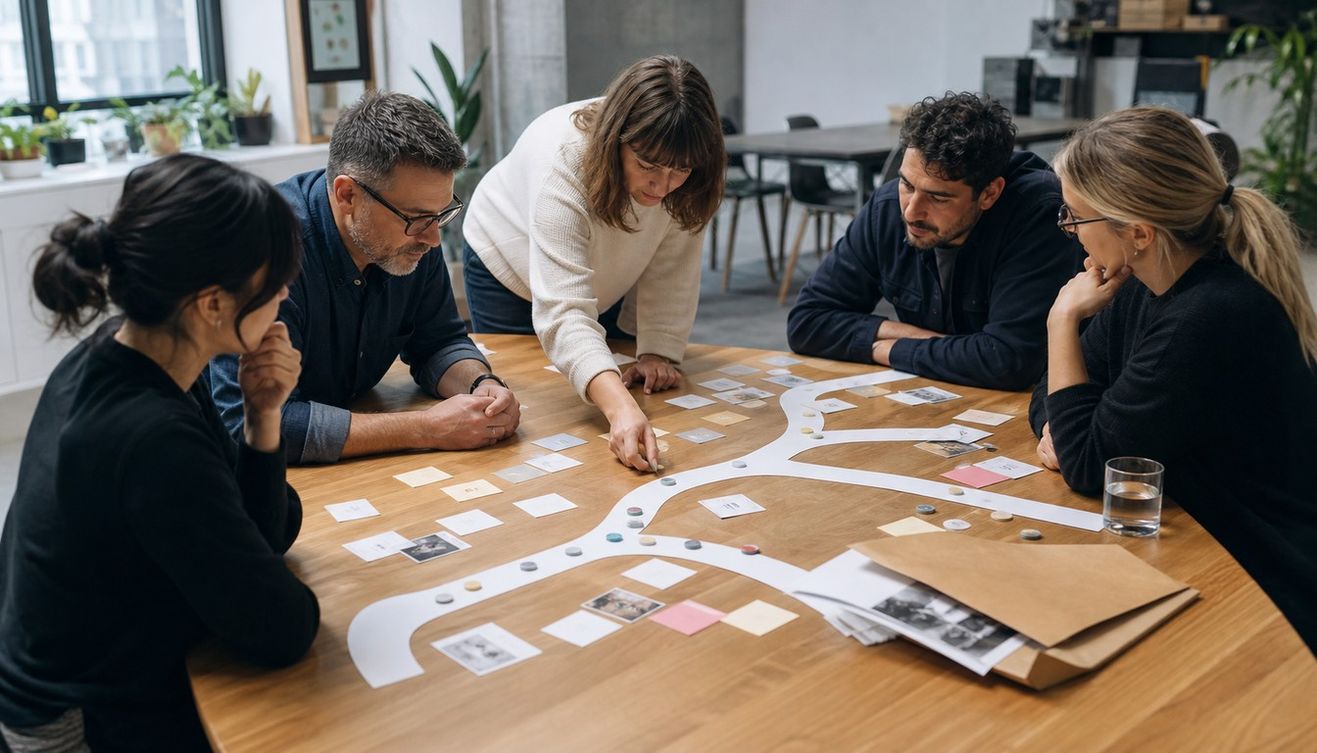
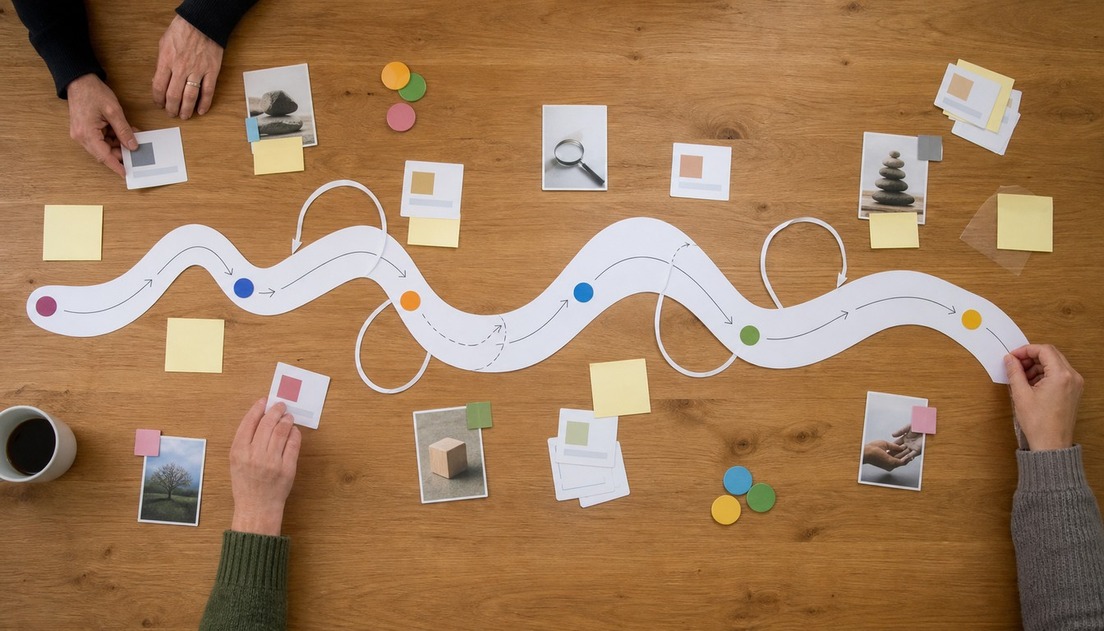
Map the consequential decisions in the journey, not merely the pages visited or buttons pressed. At each decision point, record five separate lenses: open questions, evidence needs, perceived risks, decision criteria and handoff concerns. Add the research basis, confidence, authorised owner and next check before proposing a change. This exposes the difference between a missing answer, weak proof, an unacceptable consequence, an unclear comparison and a handover that may lose context. Repeated visits or an abandoned form can show where investigation is warranted, but those behaviours do not reveal the reason on their own.
The method at a glance
Map consequential decisions rather than treating pages and clicks as the journey.
Record open questions, evidence needs, perceived risks, decision criteria and handoff concerns separately.
Use analytics to locate investigation points, not to infer private motives.
Prioritise with evidence and consequence in view, not solely by closeness to a call to action.
Continue through confirmation and follow-up when context, timing or recovery remains uncertain.
What belongs in a high-consideration uncertainty map?
A high-consideration uncertainty map should contain every consequential decision for which the organisation-owned website must explain something, receive information, preserve context or support a handover. High consideration is an operational description, not a fixed euro value or procurement timetable: it applies where cost, complexity, scrutiny, switching effort, implementation dependency, reputational exposure or difficult-to-reverse consequences make careful evaluation reasonable. Begin with the decision a person or group is trying to make, then identify the website’s responsibility at that moment.
Use discovery, orientation, evaluation, action, confirmation and follow-up as a flexible scaffold. The journey may loop when an evaluator returns with a colleague’s question, branch when different services suit different situations, pause during internal approval or move from the website to a conversation. Those phases do not prescribe a linear funnel or require six separate pages. They simply stop the team ending its view at form submission or arranging the map around its own site structure.
Include off-site research and human contact only where they reveal a website responsibility. A comparison discussed in a private meeting may show that scope needs clearer website evidence; a sales conversation may show that the enquiry handover failed to carry information already supplied. Record the map’s limits as well. B2B journeys can involve buying and usage participants with different goals, direct and indirect touchpoints, and activity the supplier cannot observe. A useful map makes those blind spots visible instead of filling them with confident assumptions.
How do you turn research into one usable uncertainty-ledger row?
Turn research into a usable row by naming one decision point and keeping evidence, interpretation and ownership visibly separate. Use this sequence: phase; decision point; open questions; evidence needs; perceived risks; decision criteria; handoff concerns; research basis; confidence; owner; intervention; next check. Write questions in language participants actually used where possible. Label anything created by the team as a hypothesis. An unsupported entry is a research task, not a user truth made credible by neat formatting.
Reconstruct what participants did, asked, compared, expected, thought and felt through interviews, observed evaluations or other suitable qualitative work. Corroborate the emerging account with support and sales records, operational records, internal search terms, journey behaviour, form errors, and content or claim inventories. Analytics may locate loops, exits, repeated visits, search refinement or movement to another channel. They cannot, by themselves, establish that somebody feared the price, distrusted a claim or rejected a particular criterion.
Keep organisation-provided proof separate from information the user must supply. An evaluator may need a credible account of migration scope and method; the enquiry process may separately require details of the existing platform. Mixing those fields can make a content gap look like form friction, or make unnecessary collection look like evidence. Use plain confidence labels such as “corroborated across sources”, “observed repeatedly”, “observed once” or “assumption”. Qualitative research has identified several kinds of perceived B2B risk, but those categories are prompts for enquiry rather than a universal ranking.
A polished map does not remove uncertainty if the map itself hides assumptions.
Copy-ready uncertainty-ledger template for one consequential decision
Ledger field
Question to answer
Research basis and confidence
Owner, intervention and next check
Phase
Where in the flexible journey scaffold does this decision arise?
Name the research record; label confidence plainly.
Identify the team maintaining this context.
Decision point
What is the person or group deciding now?
Quote or summarise the observed decision without inventing motive.
Name the owner accountable for enabling it.
Open questions
What remains unresolved in the participant’s own terms?
Separate heard questions from team hypotheses.
Answer, clarify or schedule research.
Evidence needs
What credible proof would support the relevant claim?
Record which participants requested or used it.
Provide suitable proof and test whether it is understood.
Perceived risks
What consequence is the participant trying to avoid?
Preserve uncertainty and differences between participants.
Reduce the avoidable risk or explain the genuine constraint.
Decision criteria
How is an acceptable option distinguished from an unacceptable one?
Show whose criterion it is and how often it appeared.
Enable comparison without imposing a generic ranking.
Handoff concerns
What context, acknowledgement, timing or recovery route is expected?
Check research and operational handover records.
Repair the handover and audit context transfer.
User-supplied input
What information or evidence must the participant provide?
Confirm that each request serves the process.
Remove unnecessary requests or explain why they matter.
Current answer
Is the answer absent, hidden, inconsistent, unsupported or undermined later?
Audit content, claims, interfaces and operations.
Fix the actual failure rather than adding volume.
Intervention
What proportionate change fits the evidence?
State the hypothesis and its confidence.
Assign an authorised content, design or operational owner.
Next check
What evidence will be examined after the change?
Choose research, behaviour or an operational result.
Record the date, owner and result in the ledger.
How does uncertainty change from discovery through follow-up?
Uncertainty changes as the decision changes, so the same generic reassurance cannot serve the whole journey. Discovery concerns relevance and legitimacy; orientation concerns the applicable route; evaluation concerns criteria and proof; action concerns effort and commitment; confirmation concerns whether the action succeeded; and follow-up concerns ownership, timing and preserved context. Different participants may enter at different points or revisit an earlier question after internal scrutiny, so research should establish their actual goals rather than forcing them into one persona.
Discovery: make the problem, intended audience, scope and destination recognisable enough for someone to decide whether further investigation is worthwhile.
Orientation: distinguish available paths, terminology and prerequisites, with access to human help where fit cannot be resolved through self-service.
Evaluation: support participants’ criteria, trade-offs, implementation concerns and proof needs without assuming a feature list represents the whole buying group.
Action: explain required information, effort, relevant cost, timing, consequences and what the action authorises; provide instructions, validation, progress and review where appropriate.
Confirmation: state whether the action succeeded and, where relevant, provide a reference, usable record, immediate next step and recovery route.
Follow-up: make ownership, expected timing, further actions, transferred context, status and routes for help clear.
Consider a hypothetical organisation evaluating a partner for a complex website-content migration. Discovery establishes whether this service covers a migration of that kind. Orientation distinguishes possible paths and prerequisites. Evaluation asks whether migration is included, what the method covers and whether approval roles will be preserved. Here, visible scope is the needed answer, method evidence is the proof, rework or delay is the perceived consequence, acceptable coverage is a decision criterion, and carrying the evaluator’s context into contact is the handoff concern.
At action, the enquiry should make required information and the nature of the commitment clear while avoiding irrelevant or excessive input. Accessible form guidance supports labels, instructions, validation, suitable confirmation or undo, notifications and progress information. Confirmation should acknowledge receipt and provide a reference when relevant. Follow-up should set a response expectation and preserve the migration context already supplied. None of those steps proves that conversion will improve; each is an intervention to check through subsequent research, behaviour or operational evidence.
How should the team prioritise and resolve uncertainty barriers?
Prioritise barriers qualitatively by examining the decision affected, the plausible consequence if the barrier remains, how reversible that consequence is, how broadly the evidence suggests it reaches relevant participants, and how strong the evidence is. Then assess the current answer, the team’s ability to resolve the problem and the evidence that will be checked next. This is an operating judgement, not a predictive score. Do not give automatic priority to whatever sits nearest a call to action.
Which consequential decision is blocked, distorted or postponed?
What may happen if the barrier remains, and how reversible is that consequence?
How many relevant participants does the available evidence suggest it reaches?
How strong is the evidence that the barrier exists?
Is the current answer absent, hidden, inconsistent, unsupported or undone by the handover?
Can the website team resolve it, or is another operational owner required?
What research finding, behaviour or operational result will be checked next?
Audit the current answer before commissioning more content. A well-supported answer may already exist but be difficult to find, poorly timed or contradicted elsewhere. The barrier may instead be excessive choice, unnecessary data collection, weak comparison support, inaccessible interaction, missing human help or a backstage process that drops context. A service-blueprint view can expose frontstage, backstage and supporting-process dependencies, helping the team distinguish a page problem from an operational handover that content alone cannot repair.
Choose an intervention proportionate to the evidence: clarify or remove content, narrow scope, strengthen support for a claim, enable comparison, reduce avoidable input, improve instructions, provide suitable help, repair confirmation or change the underlying process. Assign the person authorised to make that change, not merely the person maintaining the map. Name the next check without promising a gain in conversion, revenue, cycle time or satisfaction. Low-confidence entries should move into a research lane; disagreement among participants should remain visible rather than being averaged away.
Maintain the ledger as an evidence record rather than a photograph from a workshop. Link decisions to research, record changes in confidence, preserve superseded findings and note what happened after each intervention. Where resolution depends on accessibility, privacy, security, legal or regulated-domain judgement, flag that dependency for an appropriately qualified specialist instead of treating the map as a compliance determination. The map has done its job when ownership, evidence limits and the next responsible action remain clear after the workshop materials are put away.
Frequently asked questions
What is a customer journey uncertainty map?
It is a decision-centred journey record that applies five lenses at each consequential point: open questions, evidence needs, perceived risks, decision criteria and handoff concerns. It also records the research basis, confidence, owner, intervention and next check. This exact framework is a practical editorial synthesis, not an official standard or predictive conversion model.
How do you map B2B buyer questions and risks?
Reconstruct consequential decisions through interviews, observed evaluations or other suitable qualitative research, then corroborate the account with behavioural and operational evidence. Preserve differences between participants rather than forcing one common ranking. Label unsupported entries as assumptions and make research the next action.
What evidence should a high-consideration website provide?
The right proof depends on the decision and the claim. It may include visible scope, method, comparison support, a demonstration, customer evidence, policy or process information, or accessibility information. Keep proof supplied by the organisation separate from documents or data the user must provide.
How do you identify the most important website decision barriers?
Consider decision importance, plausible consequence and reversibility, reach, evidence strength, current-answer adequacy, resolvability and the planned next check. Use those questions qualitatively rather than turning uncertain judgements into a score. Proximity to a call to action is not sufficient on its own.
How should a website handle a journey handover?
Set expectations before the action, acknowledge success and preserve the relevant context when responsibility moves to another person or system. Make ownership, expected timing and any required next action clear. Provide a contact, recovery or status route appropriate to the journey.
References and Sources
This article was researched using the following sources:
We cover the decisions that shape a website long after launch. Our work starts from named sources, separates what we found from what we think, and uses AI assistance for research and drafting under documented editorial standards. We disclose commercial relationships wherever they exist.